domingo, 17 de febrero de 2013

· "THE BEATLES' SECOND ALBUM" - The Beatles USA 1964

The Beatles' Second Album is The Beatles' second Capitol Records album, and their third album released in the United States including Introducing... The Beatles released three months earlier on Vee-Jay Records. The Beatles' Second Album went to number 1 on the album charts in the US, knocking off Meet the Beatles!, the first time an artist replaced itself at number one on the US album charts. Unlike the contemporaneous British Beatles albums, The Beatles' Second Album is composed exclusively of uptempo numbers, and for this reason is a favourite of some Beatles aficionados and rock critics. "The Beatles' Second Album stands as probably best pure rock & roll album ever issued of the group's music" [sic], wrote Allmusic. Songs for this album were compiled from four different UK releases. Included were the five remaining tracks from the group's second British LP With the Beatles. Those songs were left off the previous Capitol album Meet the Beatles!. Also included were "Thank You Girl" (the B-side to the British single "From Me to You"), the single "She Loves You" / "I'll Get You", "You Can't Do That" from the A Hard Day's Night soundtrack LP in the UK, and two new songs, "Long Tall Sally" and "I Call Your Name," both released a month later in the UK on the Long Tall Sally EP. Also, the Capitol Records engineers, headed by record executive Dave Dexter, Jr, added a lot of echo and reverb to give the music more of a "live" feel. This is much more noticeable on the With the Beatles tracks, as they were recorded in two-track stereo. Exceptional is the inclusion of the stereo version of "Thank You Girl," as The Beatles' Second Album featured the only true stereo version of the song released on any US or UK album for over 40 years, until the same stereo version of the song (but with no echo added this time) was released on the 2009 remastered edition of Past Masters (The Beatles' Second Album stereo version of "Thank You Girl" was also included on The Beatles Beat, a German compilation release). Since all the echo added, this version remains a bit of a rarity. For its American-album debut in mono, Capitol took this stereo version and transferred it into a two-to-one stereo-to-mono mixdown for the mono album release, thus creating an alternative mono mix of the song. The stereo version of "Money" also underwent the same two-to-one stereo-to-mono mixdown for this album, thus creating another alternative mono mix. In the mono version of "I Call Your Name", the cowbell comes in at the very beginning of the song, whereas in the stereo version it comes in after the beginning of the vocal. Harrison's opening 12-string guitar phrase is also different between the mono and stereo versions. In "Long Tall Sally", the stereo version has echo while the mono version is lacking it. "You Can't Do That" is a different mono mix to the one released on the British album A Hard Day's Night for unknown reasons. Mark Lewisohn says that an alternative mono mix was sent by mistake instead of the UK master. This album was also released in the US on 8-track cartridge in 1967, and reel to reel tape and cassette in 1969. In 2004 this album was re-released for the first time on CD as part of The Capitol Albums, Volume 1 box set and was issued in a miniature cardboard replica of the original album sleeve.

Photobucket


01- Roll Over, Beethoven
02- Thank You Girl
03- You Really Got a Hold on Me
04- Devil in Her Heart
05- Money
06- You Can't Do That
07- Long Tall Sally
08- I Call Your Name
09- Please Mr. Postman
10- I'll Get You
11- She Loves You

· "A HARD DAY'S NIGHT" LP recording sessions

First Paris at EMI Pathé studios, then London at Abbey Road, and finally the whole world...

Photobucket


01: Komm Gib Mir Deine Hand [Take 1]
02: Komm Gib Mir Deine Hand [Take 2]
03: Komm Gib Mir Deine Hand [Take 7]
04: Komm Gib Mir Deine Hand [Take 9]
05: Komm Gib Mir Deine Hand [Take 10]
06: Komm Gib Mir Deine Hand [Take xx]
07: Sie Liebt Dich [Take xx]
08: Can't Buy Me Love [Take 1]
09: Can't Buy Me Love [Take 2]
10: Can't Buy Me Love [Take 3]
11: Can't Buy Me Love [Take 4]
12: You Can't Do That [Take 6]
13: You Can't Do That [Take 9]
14: Can't Buy Me Love [Take 4 - RM1]
15: And I Love Her [Unknown Take]
16: And I Love Her [Take 2]
17: I Should Have Known Better [Take 8]
18: I Should Have Known Better [Take 11]
19: I Should Have Known Better [Take 22 – RM1]
20: And I Love Her [Take 11]
21: And I Love Her [Take 21 – RM1]
22: And I Love Her [Take 21 – RS1 - Frags.]
23: Tell Me Why [Take 2]
24: Tell Me Why [Take 4]
25: Tell Me Why [Take 8 – RM1]
26: If I Fell [Unknown Take]
27: If I Fell [Take 15 – RM1]
28: If I Fell [Take 15 – Lead guitar + vocals]
29: I’m Happy Just to Dance with You [Take 4 – RM1]
30: I Call Your Name [Studio chat]
31: Train Music
32: A Hard Day's Night [Take 1]
33: A Hard Day's Night [Take 2]
34: A Hard Day's Night [Take 3]
35: A Hard Day's Night [Take 4]
36: A Hard Day's Night [Take 5]
37: A Hard Day's Night [Take 6]
38: A Hard Day's Night [Take 7]
39: A Hard Day's Night [Take 8]
40: A Hard Day's Night [Take 9]
41: A Hard Day's Night [Overdubs onto Take 9]
42: A Hard Day's Night [RM1]
43: A Hard Day's Night [RS1]
44: I'll Be Back [Take 2]
45: I'll Be Back [Take 3]
46: I'll Be Back [Take 12]
47: I'll Be Back [Take 13]
48: I'll Be Back [Take 14]
49: I'll Be Back [Take 15]
50: Anytime at All [Take 11]
51: You Know What To Do [demo take 1]
52: No Reply [demo take 1]

Bonus Tracks:
53-58: A Hard Day's Night [Monitor mixes - Takes 1-6]
59: A Hard Day's Night [Rough mono pre-mix]
60: A Hard Day's Night [Rough stereo pre-mix]

sábado, 16 de febrero de 2013

· "CON LOS BEATLES" (With The Beatles Argentinian LP)

Recording first published:
Mono, 7 February 1964
Stereo, June 1972

 photo LP2S-1-2_zps3b83d86e.jpg


· "POR FAVOR, YO" (Please Please Me Argentinian LP)

Recording first published:
Mono, 7 February 1964
Stereo, April 1972

 photo LP1S-1_zps07d38fc5.jpg


· "MEET THE BEATLES!" - The Beatles USA 1964

Meet The Beatles! was the second Beatles' album released in the United States, despite the "first album" claim on its cover. Released on 20 January 1964, it was the first Capitol Records Beatles' album, issued in both mono and stereo. Capitol is a sister company to Parlophone, the Beatles' British label, and both are subsidiaries of EMI. Ten days prior to the release of Meet the Beatles!, Chicago's Vee-Jay Records released The Beatles' first album, Introducing... The Beatles, which had been delayed for release from the previous summer. Perhaps as a result of the Vee-Jay release, Liberty Music Shops advertised in the New York Times of 12 January 1964 that Meet The Beatles! was available for purchase, an ad not authorized by Capitol. The cover featured Robert Freeman's portrait that was used for the U.K. With The Beatles release with a tinted blue hue added to the original, stark black-and-white photograph. Meet The Beatles! reached the number one spot on Billboard album charts starting on February 15th, 1964. It remained at number one for an impressive 11 weeks before being replaced by The Beatles' Second Album; the first time that an artist replaced itself at the number one album position. In 2003, Meet The Beatles! was ranked number 59 on Rolling Stone magazine's list of the 500 greatest albums of all time. In 2004, the album was released on CD in stereo and mono as part of The Capitol Albums, Volume 1 box set.

Photobucket


01- I Want to Hold Your Hand
02- I Saw Her Standing There
03- This Boy
04- It Won't Be Long
05- All I've Got to Do
06- All My Loving
07- Don't Bother Me
08- Little Child
09- Till There Was You
10- Hold Me Tight
11- I Wanna Be Your Man
12- Not a Second Time

· "INTRODUCING THE BEATLES" - The Beatles USA 1964

Introducing... The Beatles is the first Beatles album in the United States. Originally scheduled for a July 1963 release, the LP finally came out on 10 January 1964, mere days before Capitol's Meet The Beatles!. It was the subject of much legal wrangling, but ultimately, Vee-Jay Records was permitted to sell the album until the fall of 1964, by which time it had sold more than 1.3 million copies. When it issued the "Please Please Me" single in the United States, Vee-Jay Records signed a licensing agreement with Transglobal, an EMI affiliate that worked to place foreign masters with U.S. record labels, giving it the right of first refusal on Beatles records for five years. As part of that agreement, Vee-Jay planned to release the UK Please Please Me album in the U.S., and received copies of the mono and stereo master tapes in late April or early May of 1963. Originally, Vee-Jay considered releasing the album exactly as it appeared in England. A surviving acetate made by Universal Recording Corporation of Chicago, probably in May 1963, contains all 14 songs in the same order as on the UK album, with the title still listed as Please Please Me. But in keeping with the American norm of a 12-song album, Vee-Jay chose instead to delete the songs "Please Please Me" and "Ask Me Why" and change the album's title to Introducing... The Beatles. Also, the engineer at Universal in Chicago thought that Paul McCartney's count-in at the start of "I Saw Her Standing There" was extraneous rather than intentionally placed there, so he snipped the "one, two, three" from Vee-Jay's mono and stereo masters. Except for those deletions, the order and contents of the album were untouched, resulting in a U.S. album that bore the closest resemblance to a British Beatles LP until Capitol’s Revolver in 1966. Preparations for the LP's release continued in late June and early July 1963, including the manufacturing of masters and metal parts and the printing of 6,000 front covers. But, despite the claims of many older books that Introducing The Beatles was first released on 22 July 1963 no paper trail exists to suggest that the album was released at any time in 1963. After a management shake-up at the label, which included the resignation of company president Ewart Abner after he used company funds to cover gambling debts, Vee-Jay canceled Introducing The Beatles. On 14 December 1963, Billboard magazine mentioned that Capitol Records planned an all-out promotional campaign for the Beatles in the United States. On 7 January 1964, Vee-Jay's board of directors met for the first time since that announcement, and it discussed the Beatles' material it had in the vault. Desperate for cash, the board decided to release IntroducingThe Beatles, even if it meant legal trouble in the future. Metal parts were already at Vee-Jay's three primary pressing plants, and 6,000 front covers were already printed. All of these were available on the market within days of the 10 January release date. On 16 January 1964, Introducing... The Beatles was finally released, but Vee-Jay was served with a restraining order stopping further distribution. Beechwood Music, Inc., Capitol Records' publishing subsidiary, owned the American publishing rights to "Love Me Do" and "P.S. I Love You", and because the two songs had not yet been officially released in the U.S., Beechwood refused to issue a license for Vee-Jay to release them. Approximately 80,000 copies of the album had been already released with the two songs on them, with only 2,000 or so in stereo. So in order to circumvent the restraining order, Vee-Jay quickly reconfigured the song list by removing "Love Me Do" and "P.S. I Love You" and replaced them with the previously deleted "Ask Me Why" and "Please Please Me”. The new versions were prepared in late January and began appearing in stores approximately 10 February 1964. Because of the initial restraining order, Introducing... The Beatles did not enter the Billboard album charts until one week after Meet the Beatles!. Once it did, it quickly rose to the #2 spot, where it stayed for nine straight weeks. It also peaked at #2 in Cash Box, and it got to #1 in Record World magazine. It is interesting to note that the song "I Saw Her Standing There", which was first released in the U.K. on the album Please Please Me, appeared in the U.S. on both the Vee-Jay album as well as Capitol's Meet The Beatles! LP. These two albums were initially issued almost simultaneously, marking the only time that 2 different Beatles albums, each from a different record label, were released at around the same time with one song appearing on both albums. In the other hand, the songs “Misery” and “There’s a Place” were first released by Capitol as part of the Rarities US album in 1980, and remained almost as unreleased songs since October 1964 when Vee Jay stopped distributing Introducing The Beatles. The rest of the songs were included in The Early Beatles, released by Capitol in mid-1965, which had very poor sales compared to the rest of the other Beatles records released back then, mainly due to the previous Vee Jay release of Introducing... The Beatles. Here’s the second version released on early February 1964 from the original Vee Jay stereo and mono LPs.

 Photobucket


01- I Saw Her Standing There
02- Misery
03- Anna [Go to Him]
04- Chains
05- Boys
06- Ask Me Why
07- Please Please Me
08- Baby It's You
09- Do You Want to Know a Secret?
10- A Taste of Honey
11- There's a Place
12- Twist & Shout

sábado, 9 de febrero de 2013

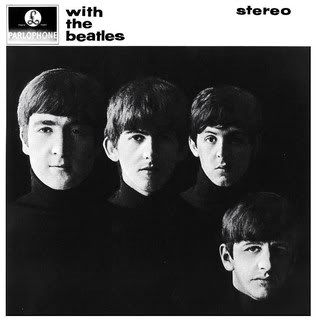
· "WITH THE BEATLES" UK LP - stereo

And this time the stereo version was released at the same time...


01- It Won't Be Long
02- All I've Got To Do
03- All My Loving
04- Don't Bother Me
05- Little Child
06- Till There Was You
07- Please Mister Postman
08- Roll Over Beethoven
09- Hold Me Tight
10- You Really Got A Hold On Me
11- I Wanna Be Your Man
12- Devil In Her Heart
13- Not A Second Time
14- Money [That's What I Want]